
How to Get Thayer County Court Records
The clerk at each court level keeps the original file. So a County Court request goes to the County Court clerk. A District Court request goes to the District Court clerk. Give the clerk a full party name plus the case year or case type. The staff can then search under the Court Records Search Policy. A case number works even better. It points straight to photocopies or certified copies. Note one limit up front. The policy does not issue a certificate saying a search came back empty.
Online, JUSTICE case information can surface a public summary, a Register of Actions, or an available image. Visitors can also use a free public terminal or kiosk at the courthouse during court access hours. The policy lists law-library access too. Phone and email work for asking the right clerk whether a record is public. They also cover how to order it. A written request should name the court and the case number if known. Add the full party name, the year or case type, and the document or date range wanted. Include plain versus certified format, a delivery choice, and contact details. The state electronic-filing service serves authorized filers only. It is not built for docket reading or copy requests.
- Identify the correct Thayer court and the specific record, entry, image, copy, or transcript needed.
- Use JUSTICE, a courthouse terminal, or the clerk to confirm the public case number and Register of Actions.
- Give the clerk the party name, case year or type, case number when known, and the exact document or entry.
- Ask whether a plain copy, certified copy, paper delivery, electronic delivery, pickup, or mailing is available.
- Confirm the current cost and any estimate before the office prepares the requested material.
Thayer County offers no dedicated web form or special email address for docket requests. A published clerk email address is a contact point, not a promise that every copy can go out electronically.
Thayer Court Records Request Limits
Public access runs on equal terms. But court-specific rules cap what a clerk may release. Ask for a case or a document, not a person's whole record. Restricted? Ask the clerk what form, court order, or identification is required. Clerks explain procedure and point you to the right office. They cannot give legal advice.
For sealing, start with the official Nebraska adult record sealing information. The self-help page lays out the eligible adult process.
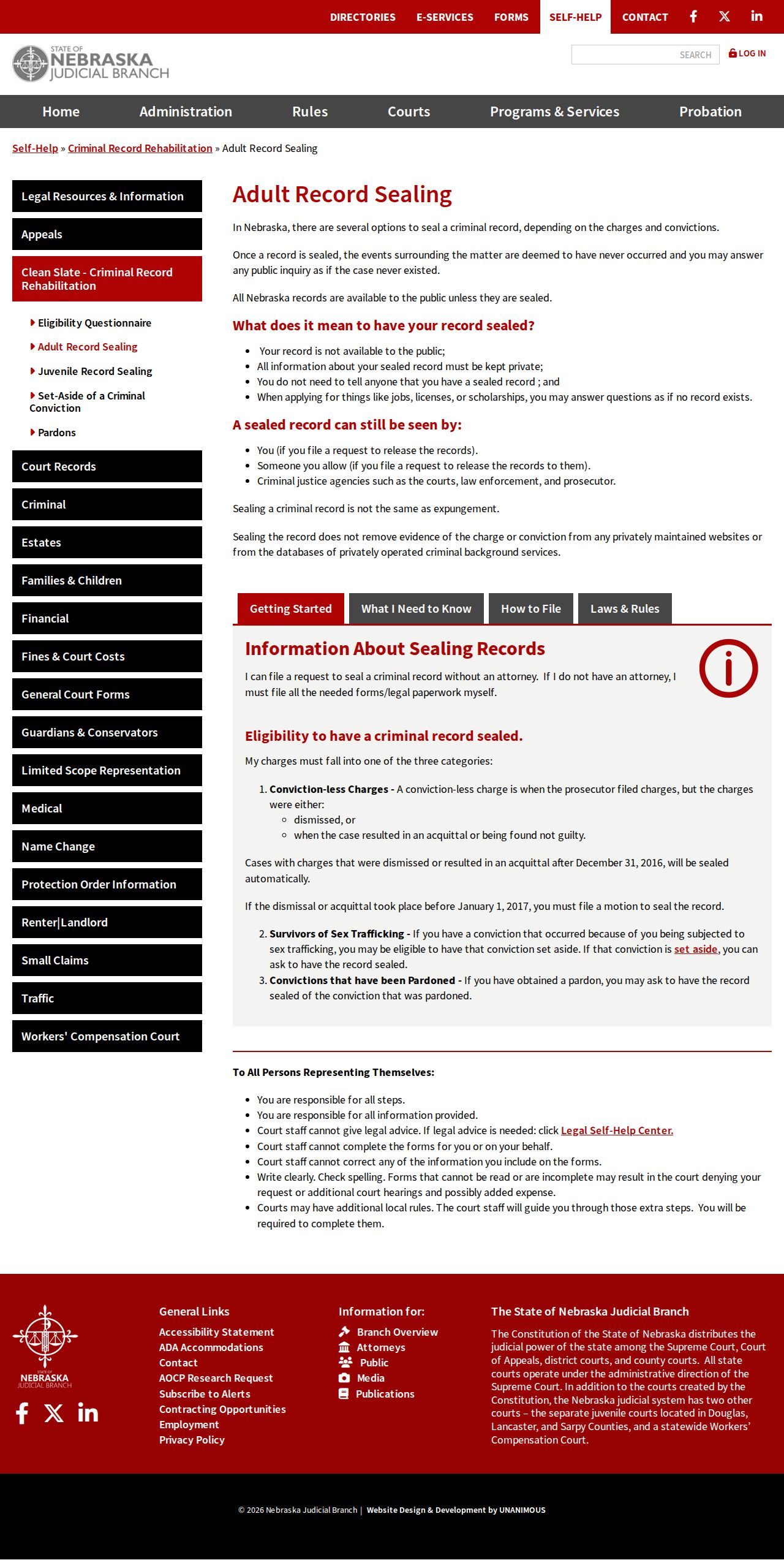
That sealing material draws a useful line. A public record request and a restricted-record request are two different transactions, and treating them the same invites delay.
Types of Thayer County Court Records
Match the product to the need. A Register of Actions lists events in order. A document image is the actual filed paper or electronic filing, when one is available. The clerk supplies plain or certified copies. A typed transcript or digital recording captures what was said in a proceeding. Different sources, formats, and costs attach to each.
- Case summary and party listing from the public statewide system when available.
- Register of Actions entries for the sequence of publicly accessible case events.
- Public document images, orders, judgments, and filed papers when available.
- Plain photocopies or certified copies from the proper Thayer clerk.
- Typed transcripts or digital recordings requested through the applicable court process.
Statewide, most filed documents appear as electronic images. Documents filed or uploaded after April 16, 2008 mark the main availability line. A missing image may reflect that date. It could also reflect system history or a restriction. A short register entry never lets a reader rebuild the document itself.
Thayer Court Records Register or File
A Thayer Register of Actions shows one thing. The court recorded an event. It is not the order. It is not the judgment, the exhibit, or anything spoken. Use it to pin down a date. Then ask the clerk for a copy, or pull the public image if one exists. For spoken proceedings, take the transcript or digital-recording route instead.
| Product | What it supplies | Thayer access path |
|---|---|---|
| Register of Actions | Chronological public case events. | JUSTICE, public terminal, or clerk search. |
| Document image | Public filed document where available. | Linked statewide case information or clerk copy request. |
| Plain or certified copy | Clerk-provided reproduction, with certification when requested. | Correct court-level clerk. |
| Transcript or recording | Proceeding record requested through the court process. | County-court transcript or digital-recording request route. |
The Judicial Branch transcript overview lays out the separate process for ordering a typed transcript of a trial or proceeding.
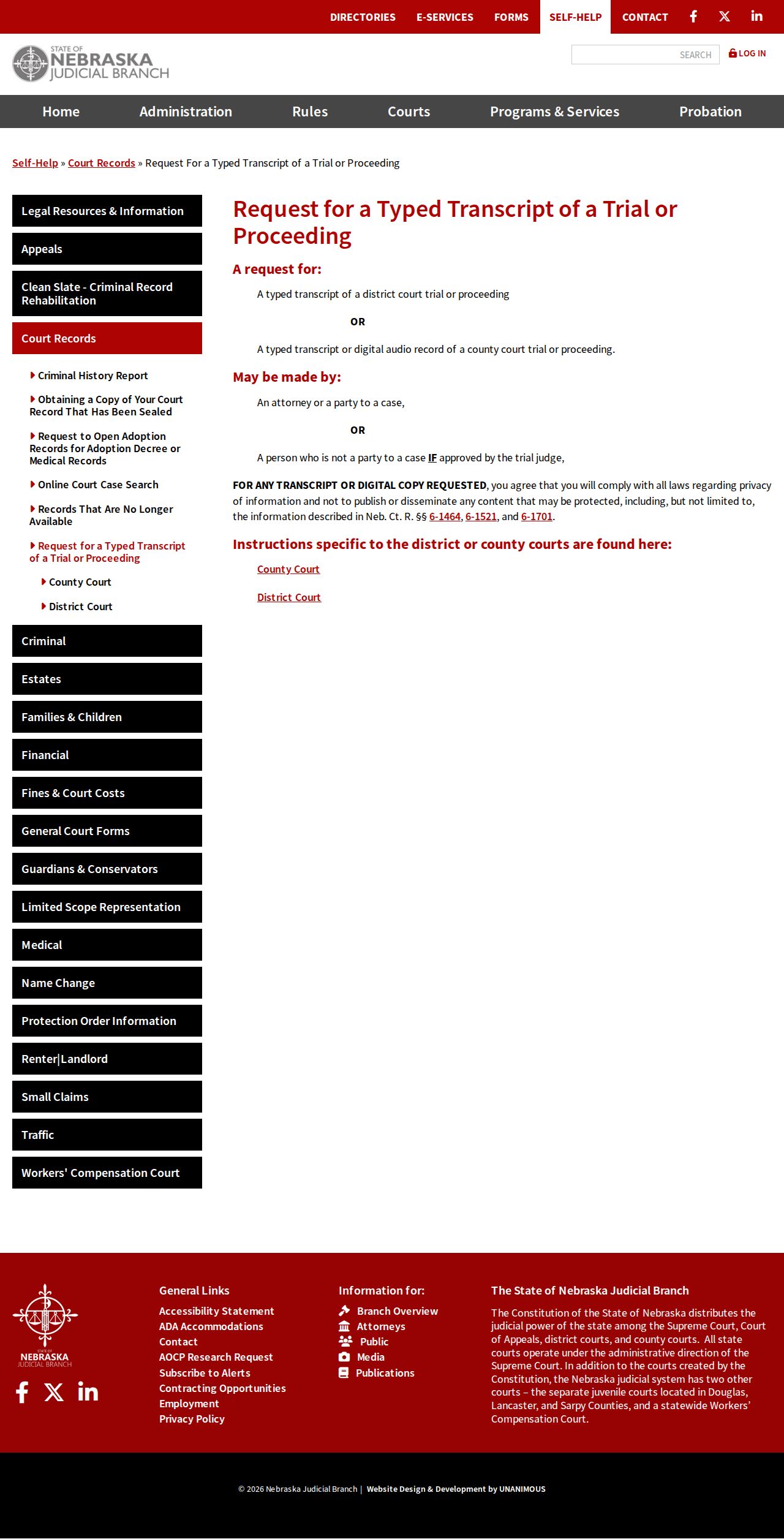
Keeping the transcript route separate protects both requests. A spoken-proceeding order differs from a Thayer Register of Actions or a document copy, and mixing them slows each one down.
What a Thayer County Court Record Contains
No two case files look alike. The case number itself encodes the court, county number, case type, year, and numeric identifier. Inside, you may find pleadings, notices, orders, judgments, a Register of Actions, and attachments. Rules and the case type govern what is public. Read a status line exactly as it appears. Never infer a result from an earlier filing.
| Case number | A structured identifier, such as C32-CR-YY-###### or D32-CI-YY-######. |
|---|---|
| Register of Actions | Chronological entries that show events recorded by the court. |
| Pleadings and notices | Public filings or notices when the particular item is available. |
| Orders and judgments | Signed rulings or dispositions, if public, rather than a mere event label. |
| Financial information | Publicly returned costs, assessments, payments, or related fields when shown. |
| Image indicator | A linked document image only when the system makes a public image available. |
A public case result can help you locate the file. The clerk remains the source for an official copy, and the full Thayer County case search path can surface a public case number before a specific request goes in.
Thayer Court Records Transcripts
Who may order a typed transcript? An attorney or a party can. A nonparty needs the judge's approval first. Form CC 1:14 collects the case and proceeding details, the portion wanted, requester contact information, delivery or pickup, and acknowledgment of payment or an estimate. The estimate comes before preparation. Rush service may cost extra.
Pricing runs in tiers, not one flat fee. Examples include original eBOE or TOP transcription near $3.75 per page, copy pages near $0.75, higher expedited rates, and separate rates for rough transcripts, media, and exhibits. Confirm the current rate with the court. For the official procedure on a Thayer request, see The County Court transcript and recording route.
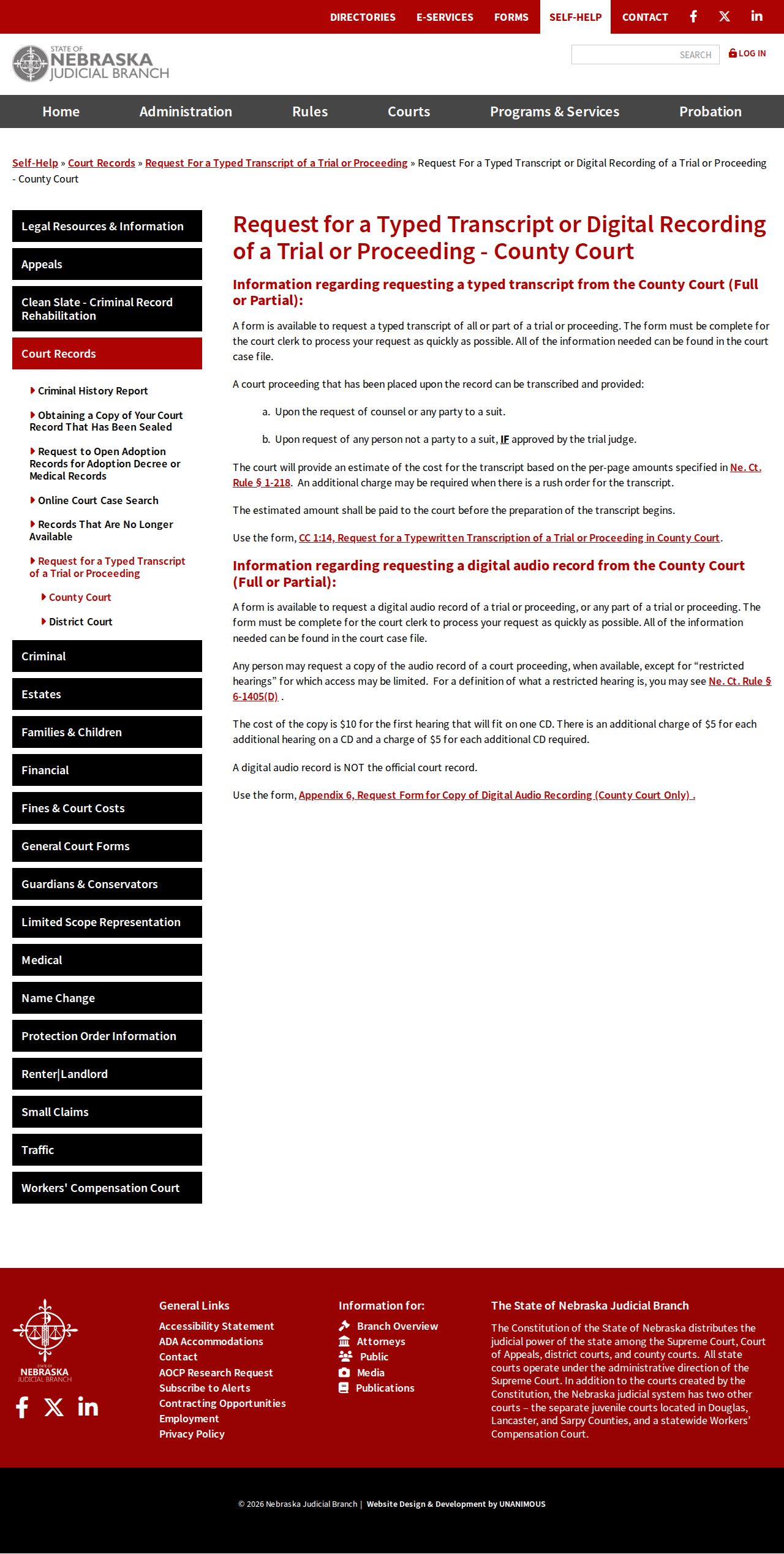
That procedure covers the spoken record. A transcript does not come back with a standard case search, and it rarely appears as an online document image. Plan ahead if you are a nonparty, because judicial approval is required, along with an estimate and some time for the court process before delivery.
Certified Copies and Fees
A plain copy is just a reproduction of the public material you asked for. A certified copy adds the clerk's seal or certification. You only need that format when the receiving person or agency demands it. So ask which one they want before the clerk starts work. Fees in County Court follow the statute. District Court copy pricing runs on its own schedule. That clerk should confirm the current amount rather than have you assume the County Court figure carries over.
| Item | Amount or request step |
|---|---|
| County Court photocopy | $0.25 per page under Nebraska §33-126.05. |
| County Court certificate and seal | $1 under Nebraska §33-126.05. |
| District Court copy or certification | Confirm the applicable current fee with the District Court clerk. |
| Transcript or recording | Request an estimate; rates and rush charges can vary by product and timing. |
Fees can change. The current Judicial Branch filing-fee schedule is dated August 29, 2026, so a copy or transcript request should still be priced by the office that will fulfill it.
Thayer Court Records Clerk Offices
Thayer County runs two clerk offices out of the same courthouse. Each keeps its own court-level records. County Court takes county criminal and traffic cases, ordinance matters, preliminary felony proceedings, limited civil cases, small claims, probate, and juvenile work. District Court handles district criminal, civil, and domestic-relations filings, plus related appeals. Know which court level holds your docket before you send a request.
County Court keeps weekday hours of 7:30 a.m. to noon and 1:00 to 4:30 p.m. Call ahead about parking, security, where the public terminal sits, or a large copying job. The Thayer County contact directory is another official local contact source.
Public Access and Sealed Records
Article 8 opens the door to eligible court information. Access comes through an authorized provider or a public terminal. What qualifies? Public party indexes, case summaries, Registers of Actions and available images, calendars, and summary details on judgments, orders, and decrees. Not everything becomes public, though. Sealed records, adoption records, protected criminal-history information, and anything else the law shields stays excluded. Juvenile matters carry extra confidentiality limits on top of that.
Key Rules:
Article 8 §1-803 provides equal public access to the same public court information, subject to law and court rules.
Article 8 §§1-804 and 1-805 describe remote or terminal access and the public case, register, image, calendar, and order-summary information that may be available.
Article 8 §1-808 excludes sealed and other protected court material from ordinary public access.
Nebraska Public Records Act §84-712 generally provides a four-business-day written-request response framework, but court restrictions still govern the requested record.
Thayer Court Records Sealed Release
Want a sealed record copy, or a release to another person? File DC 1:12 with the clerk where the case was filed. The form asks for court, county, and case number. It wants the requester and recipient too. You name the complete file or specific documents. Mailing or pickup, payment choice, and your signature or contact information complete the form. Release to the named person requires valid identification. Ask the clerk about copy, mailing, certification, deposit, and advance-payment practices.
Eligible self-help filing can happen in person, by mail, or by fax. A fax under 10 pages needs the uniform cover sheet. Anything over 10 pages needs clerk approval first. That guidance does not promise email or fax delivery of a court copy. A large public-record request may come back with an estimated access date within the Public Records Act framework.